 MileCheck
English · ਪੰਜਾਬੀ
What is my mile marker — and how do I find it?
Mile markers are the small green signs that count the miles along a highway. The number is a precise, agreed-upon answer to "where are you?" — which is exactly why 911, tow trucks, and roadside assistance ask for it. Here's how they work and how to find yours right now.
What is a mile marker?
A mile marker (also called a milepost or mile post) is a small sign along the shoulder that counts the miles traveled along a highway. Numbering starts at 0 at the southern or western edge of each state — or the beginning of the route — and counts up from there. So "mile marker 148" means you're 148 miles from that starting point.
Because the count resets at every state line, the same mile number shows up in each state a highway passes through. That's why location reports always pair the mile marker with the highway and the state: "I-90, mile 34, in Washington."
How mile markers work
- They count up as you go north or east, and down as you go south or west.
- They reset to 0 at each state line.
- Exit numbers usually match them. On most interstates, Exit 34 sits right around mile marker 34 — so exits and mile markers climb together.
- Signs aren't always exactly on the mile. You might see a marker at 33.8 for what's labeled "mile 34," and there can be a mile or two between visible signs.
How to find your mile marker right now
Three ways, fastest to slowest:
- Use the app. MileCheck reads your GPS and shows your exact mile marker continuously — interpolated to the tenth of a mile — even when there's no sign in sight or no cell signal. It's the reason the app exists.
- Look for the nearest green sign. Watch the right shoulder; the small green number is your mile marker.
- Estimate between signs. If you passed mile 33 a minute ago at highway speed, you're roughly at mile 34 now.
Why your mile marker matters
A mile marker turns "somewhere on the interstate" into an exact spot on the map. It's the single most useful thing you can tell someone who's trying to reach you:
- Calling 911. Dispatchers are trained to ask for the highway, direction, and nearest mile marker — it's how they route help to the right spot. See how to report your location on the highway.
- Roadside assistance and tow trucks. A mile marker gets a tow to you far faster than "past the gas station."
- Meeting up or tracking progress. Tell someone which mile you're at, or just know how far you've come.
See mile markers on a map
Want to see where the mile markers fall along your route? Open the live mile marker map, browse mile markers state by state, or check a specific highway on the interstate corridor pages. And along the way, the live camera map shows the actual road at thousands of those markers.
More highway basics: mile markers vs exit numbers · how interstates are numbered · US highways vs interstates · what highway sign colors mean · what "chains required" means.
How do you find a mile marker?
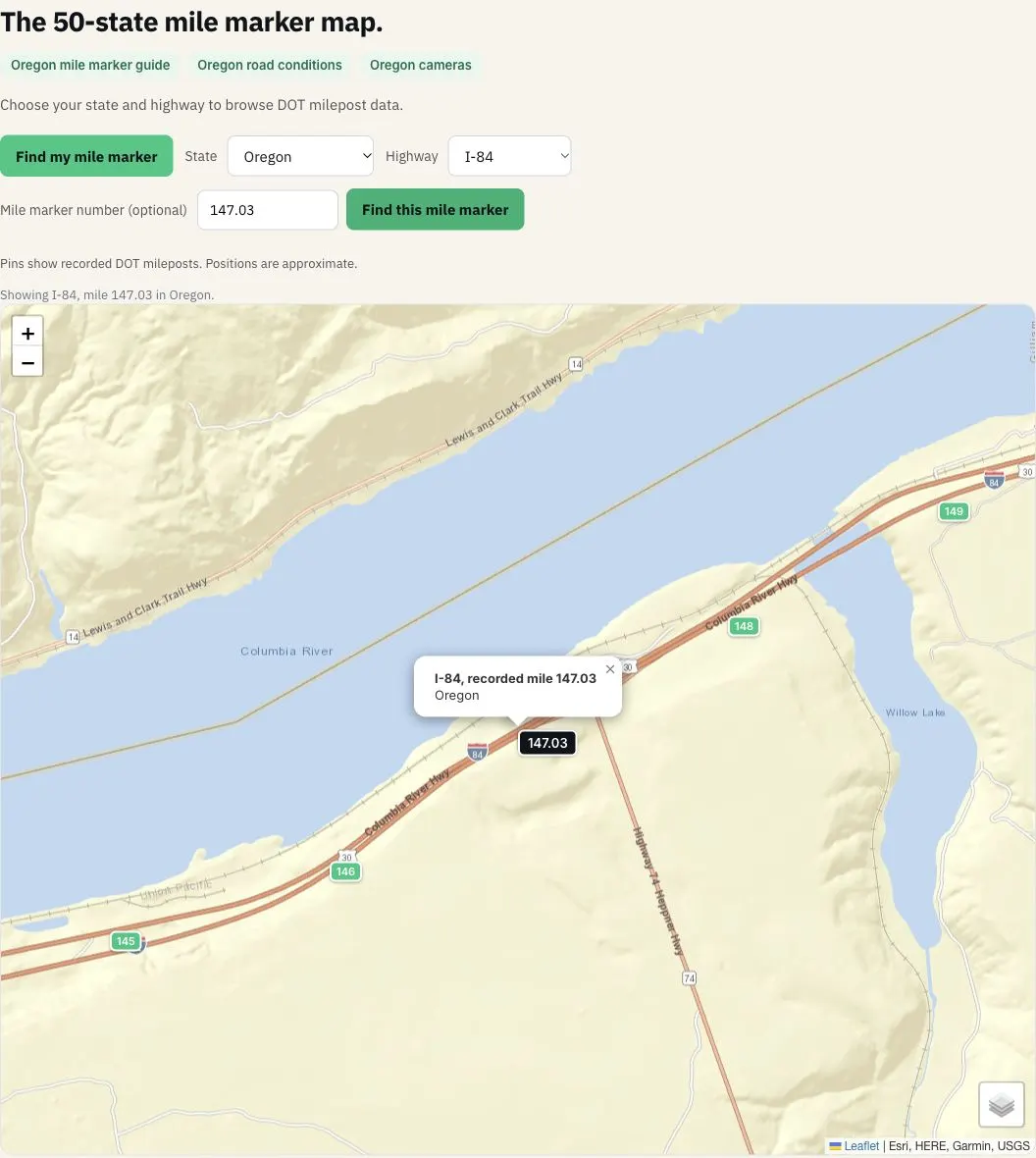
Watch the walkthrough
What does the pin show?
Pins show recorded DOT mileposts. Positions are approximate. If the requested number is missing, the tool may show a nearby recorded post and name its actual mile. It does not calculate a position between posts.
Mile marker questions, answered
How do I find my mile marker?
Look for the small green signs on the shoulder — the number is your mile marker. Between signs, estimate, or use MileCheck, which shows your exact mile marker live from GPS even with no signs in sight.
What is a mile marker?
A small roadside sign that counts the miles along a highway, starting at 0 at each state line. The number tells you your exact position, which is why 911 and roadside assistance ask for it.
Do mile markers go up or down?
They increase as you travel north or east and decrease as you travel south or west, resetting to 0 at each state line.
What's the difference between a mile marker and an exit number?
On most interstates the exit number matches the nearest mile marker — Exit 34 is near mile marker 34. The mile marker is your continuous position; exit numbers only appear at interchanges.
Know your exact mile marker — live, hands-free
MileCheck shows your nearest mile marker in real time as you drive, plus your route, direction, and nearest camera. Works offline and runs on CarPlay and Android Auto.
Crossing the Canada–US border
Driving into Canada · Driving into the US from Canada · Will my phone work in Canada? · Will my phone work in the US?